
News & Events
IDPD 13th National Conference at Hyderabad Calls for Peace and Health Security
Date: 17.05.2026
IDPD 13th National Conference at Hyderabad
Calls for Peace and Health Security
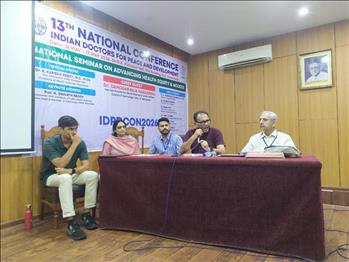
Prominent doctors, public health experts, medical teachers, and social activists from across the country gathered in Hyderabad at the IMA Building for the 13th National Conference of Indian Doctors for Peace and Development (IDPD) 16th and 17th May 2026. On the first day in a National Seminar on “Promoting Equity and Access in Healthcare” growing challenges facing India’s healthcare system were discussed. The seminar focused on strengthening the public health system, reforming medical education, and ensuring workers’ health security.
In the inaugural session, noted public health expert, Former President Public Health Foundation of India Prof. K. Srinath Reddy delivered the keynote address. He emphasized the deep connection between public health, social justice, and democratic rights. He called for the strengthening of the public healthcare system and expanded access to affordable healthcare services. Peace is the most essential to promote health as the present day wars pose an existential threat to all the flora and fauna on earth.
The conference began with an important session on “Strengthening the Public Health System and the Right to Health,” chaired by Dr. Rajni and Dr. Ranga Reddy. Speakers expressed concern over rising treatment costs for ordinary people and stressed the need for universal healthcare services. Dr. Vijay Yaldandi spoke on Universal Health Coverage: Progress, Gaps and Way Forward. Dr. Shakeel Ur Rahman spoke on Catastrophic Health Expenditure and Household Impoverishment.
Speaking on “The Role of Government versus the Market in Health Financing,” Dr. Inderveer Singh stated that healthcare should remain the responsibility of the state rather than being left to market forces.
Another session was held on Aligning Medical Education with Community Health Needs was chaired by Dr Kiran Madhala.
Dr Shanthi addressed on Coverage Gaps in ESIC: Informal Sector and Migrant Workers. Occupational Health Hazards in Emerging Industries was covered by Dr Anjali Mehta. Dr Arvind Santosh spoke on Health insurance: Lessons from States.
The session on Digital Health, AI, Holistic Care & Affordability of Medicines session was chaired by Dr Ranga Reddy. Digital Health and AI in Healthcare was dealt by Prof Ramkishan. Dr Ratnakar Palakodeti spoke on AI in medicine: Promise, Pitfalls and Equity Concerns. Dr Bharat Madhavan spoke on Telemedicine and Digital Health Platforms: Regulation and Patient Safety. Tribal healthcare delivery system in India was dealt by Dr. Narendra and Prof. Dharmakari Ramkishan
Session on Drug Price Regulation and Access to Essential Medicines was chaired by Mr Uday Bhaskar. Dr Jeetendra Singh made a presentation on DPCO and Price Capping: Achievements and Loopholes. Dr Ravindranath spoke on Patent Evergreening and TRIPS Flexibilities: Protecting Public Health.
Prof Srinivasulu Gadugu chaired the session on Holistic Care and Critique of Public-Private Partnership. Dr.Venkatesh spoke on Integrating AYUSH with Modern Medicine: Evidence and Caution. Antimicrobial Resistance (AMR) Containment: Role of Alternative Medicine ! was covered by Prof. Dr.S.Praveen Kumar. Dr Bholanath Saha spoke on PPP Models in Health: Who Benefits? Dr Sadanandam spoke on Mental Health, Palliative Care and Neglected Dimensions of Holistic Health.
Dr. Vijay Yaldandi spoke about the achievements and limitations of Universal Health Coverage, while Dr. Shakeel ur Rahman discussed the increasing burden of catastrophic healthcare expenses and their impact on poor families.
Speaking on “The Role of Government versus the Market in Health Financing,” Dr. Inderveer Singh stated that healthcare should remain the responsibility of the state rather than being left to market forces. He warned that increasing privatization and commercialization of healthcare had widened inequalities in access to treatment, especially for workers, farmers, and marginalized communities. He emphasized the need for greater public investment in healthcare and stricter regulation of private medical institutions.
The conference gave special attention to the crisis in medical education, discussed the commercialization of medical colleges, reforms in the MBBS curriculum, and linking social medicine with public health needs. Speakers said that medical education should focus on social welfare rather than profit.
Another important session dealt with ESIC and workers’ health security, focusing on health challenges faced by workers in the unorganized sector and migrant laborers. Occupational health risks in emerging industries and the limitations of insurance-based healthcare models were also reviewed.
The conference discussed emerging challenges such as digital health, artificial intelligence (AI), affordable medicines, public-private partnerships, and the future of comprehensive healthcare management.
In the session on “Digital Health, AI, Holistic Care, and Affordable Access to Medicines,” medical experts, researchers, and health workers discussed how rapid technological and policy changes are affecting India’s healthcare system.
The conference also drew attention to the poor state of healthcare in India’s tribal regions, where there is a lack of basic health infrastructure and persistent inequalities.
The session on “Drug Price Control and Access to Essential Medicines” was chaired by Mr. Uday Bhaskar. Dr. Jeetendra Singh presented a paper on the DPCO and price control mechanisms, discussing both achievements and shortcomings of the current system. Speakers stressed that essential medicines must remain affordable and accessible to all sections of society.
Speaking on “Patent Evergreening and TRIPS Flexibilities,” Dr. Ravindranath warned that monopolistic policies of multinational pharmaceutical companies pose a threat to affordable healthcare and public health.
There was also extensive discussion on a critical review of integrated healthcare systems and PPP models. In the session chaired by Prof. Srinivasulu Galugu, the increasing privatization and commercialization of the health sector were examined.
Dr. Venkatesh, speaking on the integration of AYUSH and modern medicine, said that scientific evidence and caution are essential while promoting alternative systems of treatment.
Prof. Dr. S. Praveen Kumar described antimicrobial resistance (AMR) as a major public health crisis linked to misuse of medicines and environmental pollution.
During discussions on PPP models, questions were raised about whether such models genuinely serve public interest or mainly strengthen private corporate interests. Dr. Bholanath Saha said that excessive dependence on PPP models could weaken the public healthcare system and increase inequalities in access to treatment.
Dr Sadanandam discussed on neglect areas such as mental health and palliative care, with speakers emphasizing the need for a compassionate and community-centered healthcare system.
An evening session for medical students addressed issues faced by young doctors and students — including problems of MBBS and postgraduate students, ragging, mental burnout, the NEET-NEXT policy, unemployment, and bond-related pressures. Speakers emphasized the need for democratic reforms in medical education and better working conditions for young healthcare workers.
The second day of the conference focused on global challenges affecting public health, peace, and human survival.
A morning session on “Ongoing Wars – The Threat of Nuclear Weapons and the Possibilities of Sustainable Peace” discussed the devastating effects of war and militarization on humanity. Dr Suvrat Raju, physicist from Bengaluru known for his work on black holes addressed as a guest speaker. He expressed concern about the health impacts of wars in Gaza, Ukraine, Iran, and other regions, as well as the catastrophic dangers posed by nuclear weapons. Speakers emphasized the moral responsibility of doctors and healthcare workers to raise their voices for peace.
In his special address, former co-president of IPPNW, Dr. Arun Mitra, said that growing military tensions and the arms race are draining resources needed for health, education, and welfare. Delegates stressed that public health and social justice are impossible without sustainable peace.
The session on “Strengthening Relations Among South Asian Countries” was chaired by Dr. S S Soodan and Dr. C. R. Garg. Speakers from different countries and organizations said that health, peace, and social justice are deeply interconnected.
The conference received a special message of solidarity from Dr. Inga Blum, co-president of IPPNW, who praised IDPD’s efforts for peace, nuclear disarmament, and equitable healthcare.
Dr. Asoka Hettiarachchi from Sri Lanka sent a message highlighting the role of Bangladesh, Sri Lanka, Nepal, and other South Asian countries in regional cooperation and people-centered healthcare systems.
Dr. Jaswinder Singh emphasized the need for health cooperation among SAARC countries and collective solutions to common public health challenges.
Dr. Muhammad Rakibuddin discussed issues such as medical tourism, brain drain, and migration of regional healthcare workers, saying that developing countries must strengthen their own healthcare infrastructures. Dr. Bashir Ahmad emphasized the role of people-to-people peace initiatives and international solidarity among healthcare workers.
Speaking on “Gender Issues During Wars,” Dr. Jasjit Kaur stated that wars affect women, children, and vulnerable groups differently, worsening healthcare access, nutrition, safety, and mental health.
The overall message of the conference was clear: health, peace, equality, and democracy are deeply interconnected, and protecting public health requires resisting war, privatization, and social injustice.
The afternoon organizational session focused on strengthening IDPD’s internal structure and future direction. Discussions included reports from state units, membership expansion, financial and audit reports, fundraising strategies, and major campaigns planned for 2026–28.
Delegates also discussed strengthening youth participation, enhancing international relations with global peace organizations, and building stronger democratic and public health-centered movements in India.
The conference was also addressed by AITUC General Secretary and IDPD advisor Comrade Amarjeet Kaur and senior communist leader Comrade Aziz Pasha, who conveyed their greetings and best wishes.
The conference concluded with the election of office bearers, in which Dr. Arun Mitra was elected President and Dr. Shakeel Ur Rahman was elected General Secretary. This was followed by the presidential address and a vote of thanks, reaffirming the organization’s commitment to peace, universal healthcare, scientific temper, and social justice.
The conference unanimously passed a declaration for lasting peace and health.
Declaration
The 13th National Conference of Indian Doctors for Peace and Development (IDPD), held in Hyderabad, reaffirmed that health is a fundamental human right and that peace is an essential condition for achieving health, dignity, justice, and sustainable development for all.
The conference expressed deep concern over growing inequalities in access to healthcare, increasing commercialization and privatization of healthcare and medical education, and rising out-of-pocket healthcare expenses that push millions of families into poverty every year. It firmly asserted that no person should be denied healthcare due to inability to pay.
The conference resolved that:
• Comprehensive, equitable, and affordable healthcare for every citizen must be guaranteed through a strong, publicly funded, government-run healthcare system that prioritizes the needs of the poor, marginalized communities, rural populations, tribal people, and other vulnerable groups.
• Central and state governments should significantly increase public expenditure on healthcare to ensure free or affordable access to essential medicines, diagnostics, emergency treatment, maternal and child healthcare, mental health services, and treatment for chronic diseases.
• Unchecked commercialization and profiteering in healthcare must be regulated through effective laws, price control mechanisms, ethical oversight, and strong public institutions.
• Peace, social justice, gender equality, environmental protection, and poverty reduction are inseparably linked to the goal of “Health for All.” War, violence, militarization, communal hatred, caste discrimination, and displacement have devastating effects on physical and mental health and divert valuable public resources away from healthcare, education, nutrition, and welfare.
• The conference condemned all forms of war, nuclear weapons, terrorism, communal violence, and hate-driven politics as threats to human life and public health. It appealed to all nations to prioritize dialogue, diplomacy, disarmament, and peaceful coexistence.
The 13th National Conference of IDPD pledged to continue working with national and international democratic, peace-oriented, and public health organizations to build a world free from war, inequality, hunger, disease, and injustice — a world where health, peace, and human dignity are guaranteed for all.